
Movable walls(also call operable walls) are widely used in offices, schools, hotels, and commercial environments due to their flexibility. However, without excellent sound insulation, they are just a visual barriers. Soundproof is a important part of movable wall, often a core requirement for enhancing the practicality and experiential aspects of a space. In places where privacy and focus matter, it is vital to pick movable partitions with good sound insulation. This will block sound and ensure privacy while reducing distractions.
As there have wide range of products on the market, we should understand the structure and performance of acoustic movable walls in order to select the right one.
1.Three Core Indicators of Acoustic Movable Walls
The quality of sound insulation directly determines the actual effectiveness of movable partitions. When choosing soundproof movable partitions, do not rely only on intuition. We should focus on scientific evaluation indicators:
The Most Important Technical Indicator for Sound Insulation Performance: STC
What is STC?
- STC (Sound Transmission Class, American standard) and Rw (Weighted Sound Reduction Index, European standard, similar to the Chinese GB/T standard) are core indicators for measuring a wall’s ability to block airborne sound (such as conversations and music).
What is the Meaning of STC Numbers?
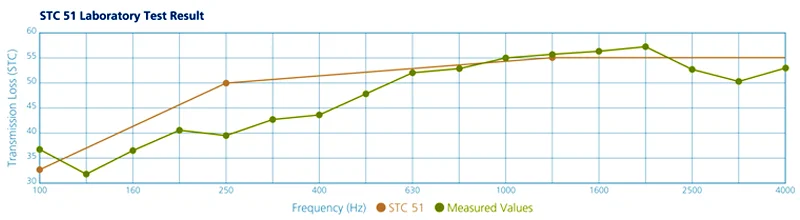
- The STC number is derived from sound attenuation values tested at sixteen standard frequencies ranging from 125 Hz to 4,000 Hz. These transmission loss values are plotted on a sound pressure level graph, and the resulting curve is compared to a standard reference contour provided by the ASTM. The higher the STC or Rw Numbers, the better the sound insulation.
Soundproofing Recommendations for Different Types of Spaces:
| STC/Rw Rating | Sound Insulation Effect | Partition Costs | Ideal Application |
| 35-40db | Loud Speaking can be Heard, but are Muffled. | 65-80USD/sqm | Suitable for the Space without High Privacy Requirements. |
| 40-45db | Normal speaking voice is Barely Audible | 85-120USD/sqm | Meeting Rooms, Office or Classroom. |
| 45-50db | Loud Conversations are Barely Audible | 120-150USD/sqm | Executive Conference Rooms, Boardrooms, and Hospital Consultation Rooms. |
| 50+db | Excellent Sound Insulation Performance | 150-200USD/sqm | Music Classrooms, High-end Hotel Banquet Halls, Courtrooms. |
NIC (Noise Isolation Class):
- Field-tested rating that measures real-world airborne sound isolation between two spaces.
Difference between STC and NIC: NIC comes from on-site testing and reflects how the full construction performs after installation, while STC is measured in a controlled lab environment without external influences.
Example: A conference room movable wall may have an STC rating of 50 in the lab. However, field tests might show a NIC of 45. This change happens when noise from ceilings and ductwork is considered. Generally speaking, a difference of 5-10 is normal.
Impact Sound Insulation (IIC)
- It primarily measures the ability to block impact sounds such as footsteps and falling objects. This is especially important for multi-story buildings or scenarios where noise from upstairs and downstairs needs to be isolated. Although movable partitions are mainly used for vertical partitioning, their structure (especially the core filling material) also affects the suppression of impact sounds.
2.Four Key Factors in Choosing High Soundproof Movable Walls
After learned the performance indicators, let’s look at the specific product design and materials.
Internal Structure and Acoustic Material: The “Soul” of Sound Insulation
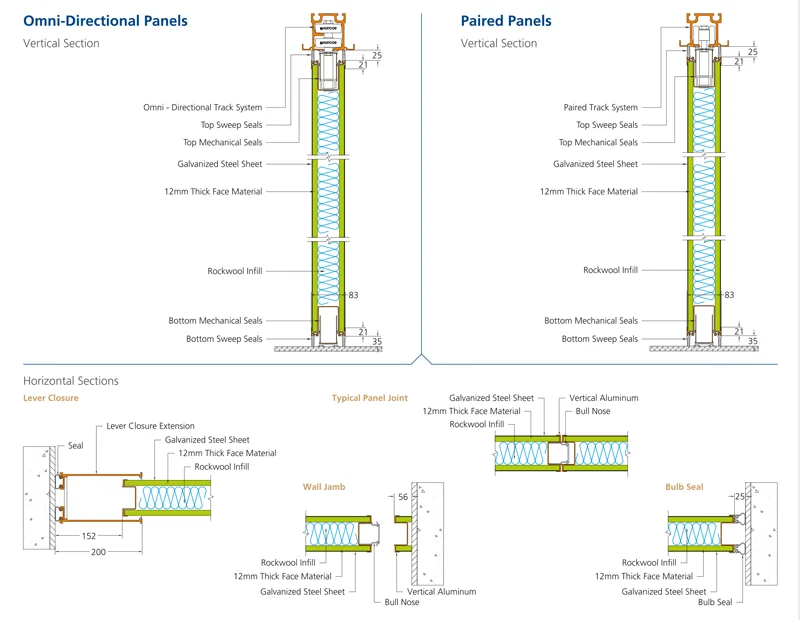
Multi-Layer Composite Structure: Single panel have limited sound insulation. Movable Walls with High STC rating typically use a “sandwich” structure, such as: steel/aluminum plate + acoustic felt + high density sound-absorbing cotton (such as rock wool, glass wool) + another layer of steel/aluminum plate. This multi-layered combination of different materials effectively dissipates and blocks sound wave energy of different frequencies.
Acoustic Material Filling: The density and thickness of the internal sound-absorbing cotton filling are crucial. High-density rock wool is a common and effective choice.
Surface Panels and Finishes: Affecting Rigidity and Sealing
Material: Steel plates are ideal for excellent sound insulation due to their high surface density and rigidity. Aluminum plates are lighter, but with proper internal structural design, they can also achieve good sound insulation levels.
Finishing: Whether it’s plasterboard, melamine board, or fabric finish, it needs to be tightly integrated with the internal structure to avoid resonance.
Sealing System: The “Lifeline” of Sound Insulation
- Top Seal: Should fit snugly against the ceiling and accommodate slight unevenness.
- Side Seal: Sealing strips at connections to fixed walls, columns, etc., must be flexible and resilient.
- Seam Seal: This is the core technology. Look for designs with double or multiple airbag seals. When the partition is closed, these airbags expand under pressure, perfectly sealing the gaps between the panels.
Rail and Suspension System: The Foundation of Stability
A smooth, robust track system ensures the partition remains aligned during movement and closure, guaranteeing effective sealing. Unstable suspension can cause misalignment of the sealing strips, creating sound leakage gaps.
3.Maintenance: Maintaining Acoustic Integrity
Even the best acoustic movable walls can fail if not properly maintained. Unlike fixed walls, movable partitions rely on moving parts for operation.
Necessary Maintenance for High Acoustic Movable Partitions
Regular Maintenance: The wear out of soundproof seal strips and mechanical operating mechanisms can wear out will cause gaps. Schedule professional maintenance checks (typically every 6 to 12 months) to inspect seals, adjust track alignment, and ensure locking bolts are fully engaged.
4.Practical Purchasing Checklist: Asking Questions to Suppliers
When communicating with suppliers, please directly ask the following questions to obtain accurate information:
- “What is the STC rating of this movable wall? Please provide the test report.” (Be sure to request a test report issued by an authoritative third-party organization; this is the most direct proof of performance.)
- “How is the sealing system specifically designed? Please show actual samples or diagrams of the top, side, and center sealing strips.”
- “What is the internal structure? What type and density of filling material is used?”
- “Are there any completed projects available for viewing or audio experience?” (If possible, on-site visits are the best way to verify this.)
- How to install the movable partition? Do you supply installation service?
Choosing a soundproof movable partition is an investment that demands a high level of technical expertise and attention to detail. Don’t be misled by appearance and price alone. Remember this formula: Superior sound insulation = Scientific internal structure + High-density acoustic material + Excellent perimeter sealing system + Stable track suspension.
Hopefully, this detailed analysis of acoustic performance will help you see through the fog and find the ideal movable partition that can flexibly divide your space while protecting your tranquility and privacy.